You Can Reverse A Stroke
in Just Ten Days
at Home!
by
Bruce Mansfield Beach

This web page will tell you how it is possible in just TEN DAYS at home to reverse a stroke for a person who has been sitting in a wheel chair for several weeks, months or years and is not able to use one of their hands and arms to feed their self.

Although the technique for achieving this reversal is not well known by the public, or most medical practitioners, the new method and results leading to such success have been demonstrated in numerous clinical studies and personal experiences (and I will provide you with the links so that you can look at them yourself).


What is amazing
about what you are about to read here -
is how we have taken this
PROVEN technique
and have improved it further
so that YOU can do it at home!

All external links
on this web page
open in a NEW window
which you can close
to return to this page

This information is being given away
Free!

We are not selling anything and this is information that you can follow through on and do at home - just like we did. If you are serious about it, I will even be glad to help you. If you are appreciative of this help and would like to provide us with a gift we would certainly accept it - but that is up to you.

If you would like to know more about us personally you might like to read one of my poems at our dog site. We work as volunteers to raise dogs for autistic children. Another interesting site is my wife's Secret of Life. You will be surprised about that. It is about worms and we send out free information all over the world about using them for composting. My main interest is Universal Auxiliary Language and you are welcome to see pictures of us at that web site also. So - you know where we are coming from and that we really do give away all this free - but once again if you are benefited by what we do and wish to be generous in return - it would certainly be a help, because we are actually very money stressed being one of those 'sub-prime borrowers' who are way behind on their payments and taxes.

If you don't want to bother with someone like ourselves, and you have lots of money, you can actually get the original version of this therapy from some established clinics (and I will give you some addresses later). They charge $5,000 and it will cost you something like that again - to fly there and spend the two weeks in a hotel. But, that way - you have someone else doing the effort.

Anyway - if you want our help you can write to me at:

[email protected]
with the subject line as: stroke
or I can be reached at (519) 925-6035

About the author

I am an old man and I too have had a stroke that left me blind in one eye, so I am sympathetic as to how suddenly a stroke can occur and affect one's life. In part that is what prompted me to study about this subject. Throughout the text you will learn more about me and how certain life experiences came to determine what we learned about reversing a stroke.

Bruce Beach (1934 - )
M.A. Economics 1970
Texas Christian University

Part One

If you are serious about using this mCIT method then you need to spend some hours studying this web site. I spent weeks searching for and studying the material presented here. The technique itself was developed through years of work by dedicated Ph.D workers in the field - so it is nothing that you spend a few hours studying this.

Index and outline:
Part 1. Alternative Therapies
    a. Medical Drugs
    b. Physical Therapy
    c. Electronic Devices
    d. Diet and herbal medicines
    e. CIT

Part 2. The Upper-limb CIT studies
    a. American Stroke Association
    b. Fourteen Clinical Studies
    c. Government Evaluation

Part 3. Lower-limb and Supplementary Therapies
    a. Using a restraint
    b. Kicking a ball
    c. A counter-intuitive approach
    d. Robotic devices

Part 4. The Drills and Equipment
    a. Balls and such
    b. Riser chair
    c. Treadmill
    d. Parallel Bars
    e. Leg restraint
    f. Mirror therapy

Part 5. What is happening - is not what you think
    a. Not a physical problem
    b. Not a matter of will
    c. What is mind?
    d. Our OPPOSITE approach

      a. Diversion
      b. Relaxation
      c. Breathing
      d. Visualization
Part 6. A True Story
    a. Our experiment
    b. Our control

Part 7. What do you want to do?
    a. What you can do
    b. What you should do
    c. What will you do?

What we mean by 'reversing' a stroke is that of changing the trend from deterioration to improvement. Many stroke victims remain in a stagnant or deteriorating situation and this technique will in just ten days put them on a path of improvement towards recovery.

It is as if you are in a car that has gone in the wrong direction and you are either continuing in that wrong direction or you have stopped. What we need to do is to reverse the car to go in the other direction towards your goal - which in this case is recovery, although recovery may take years.

Some Warnings!

Caution!

Caution!

The literature says
that for mCIT methods to work
the patient needs some initial small movement
in their:
finger (10%),
wrist (20%),
and foot.
Get help immediately in case of stroke. Learn the warning signs and call 911.

The home treatment suggested on this web page is only for those who are still in a wheelchair weeks, months or years later.

You can ask your doctor for some drugs. He will probably give you some.

Drugs

There are a great many drugs taken by stroke patients. Especially warfarin. Watch what the end of this video says on that subject.

Best to ask for documented controlled studies - and not just testimonials.

Herbs and Such

There are thousands of them. Ask your friends and you will surely be able to get ten recommended. Some of them might be very good. I wouldn't know. There are so many that one can't try them all.
There are undoubtedly many more than I know about but we tried quite a number. Once again - I recommend that you look for documented results that are supported by clinical trials.
Alternative Therapies


Part Two
The Upper Limb CIT Studies

The recommend method of this web page is mCIT. There are a variety of terms used here but we are primarily talking about the same thing. Constraint-Induced Movement Therapy (CIMT) or sometimes CIT for short and when we put the 'm' in front of it that stands for 'modified' which is practically the case in all events - because no one does it EXACTLY the same, although the core concept remains the same.

CIMT involves the "training of the paretic upper limb (six hours a day each weekday for two weeks) and restraint of the contralateral upper limb (90% of waking hours for 14 consecutive days) as described by Taub (1980)."

Okay - let us deal with some basic concepts:

a. Upper limb. We are talking about the affected arm and hand of a stroke victim. It can be either the right or left arm and hand. Initially Taub tried to also deal with the lower limb - as did other researchers - and while some clinics offer that service Taub and all the researchers that I found (with the exception of one) appear to have abandoned it. I will have more to say about this in a subsection.

b. Constraint. Can be putting the good arm in a sling or otherwise restraining it but most often we are talking about the patient wearing something like an oven mitt.

c. Time frame. Usually said to be two to three weeks but no definite criteria given for duration. The ideal is that the patient wears the restraint ALL the time for fourteen days except for sanitary purposes when going to the bathroom. It is probably not safe to use the restraint either - when using a walker.

To start studying about this - first read the following American Stroke Association report.

Note from the Heart and Stroke Association report that:

      "CIMT patients showed �large to very large� improvements in the functional use of their affected arm in their daily lives.

while -

      "Those in the control group reported no change."

Not only that, but:

      "At two-year follow-up, the CIMT group showed a large improvement in MAL scores compared to pre-treatment scores."

while -

      "Those in the placebo group displayed no significant changes."

You also want to note from the article that:

      "medical insurance does not reimburse for CI therapy. It costs about $5,000 for two weeks of treatment."

In actuality, by the time you fly a couple of people to the clinic and put them up in a hotel for the two weeks, your total cost is going to be closer to ten thousand dollars if you don't do this yourself.

Now, look at this MUST WATCH video.

We will come back to the video's content later, but for the moment you should after watching the video then look at: Constraint-induced movement therapy following stroke: A systematic review of randomised controlled trials.

What I get from these 14 studies is that they all had VERY positive results. If you want to do some really heavy reading you can look at this Government Guidelines Study.

Yes, I am familiar with the contraindication literature that "Immediate constraint-induced movement therapy causes local hyperthermia that exacerbates cerebral cortical injury in rats."

In my mind, the two key words there are "immediate" and "rats". In the first place we are not dealing with rats and in the second we are not dealing with treatment 'immediately' after inducing a stroke. So, I say, so what?

The conventional wisdom has always been that if stroke therapy was not conducted in an immediate time window after a stroke - then it would be of no avail, and I am quite in agreement that one should get treatment, within one or two hours if possible. However, we are trying to address the case here where someone has had a stroke weeks, months, possibly years ago and are no longer making any progress. The past conventional wisdom has been that there is no hope for these people while these new studies show that the stroke can still be reversed.

Let us be clear about this, if the situation has progressed so far that there is absolutely NO MOVEMENT in the hand or arm - then there is probably nothing mCIT can do. But, that does not apply to many, many cases that most people think are hopeless.

There are many other new therapies being proposed, such as through stem-cell research, the use of robotics, electrical pulse incitement, and all sorts of drugs. The cost is often prohibitive and the availability to most people - nil.

What is being proposed here can be combined with other therapies and regimens such as diet, pharmaceuticals, meditation, physical therapy, and so forth. Prayer and meditation is good. I don't recommend any 'extreme' diet. Most any good balanced diet will do. Some people feel that physical therapy is absolutely necessary - but the studies showing that have generally been conducted by physical therapists and there are other studies that do not bear that out and it can just take time and effort away during the two week mCIT process. I absolutely do not recommend drugs except under a physician's direction and even then would prefer to see them curtailed as much as possible during this process.

If after having read this far and having verified from the links what is being said here - you do not think that mCIT is what you want then you should STOP reading this web page now.

Part Three
Lower-limb and Supplementary Therapies

The reason that CONSTRAINT therapy for the leg has not been used is because while one can restrain one good arm and force the use of the other - in order to walk one must use BOTH legs so generally it has seemed just impractical or impossible to use Constraint Therapy with the lower limbs.

Personally, with Velda (see the true story below) we have used mCIT by restraining her good leg (as described in the drill section) and spending many hours having her kick a ball while sitting in her riser chair. There has been extended disagreement in our group as to the necessity of her 'kicking' rather than just moving her foot.

The problem is that in walking - Velda drags her foot or walks on her toe. This has been unnoticable to other observers here but because my father was in the business of fitting remedial footwear and because I had to deal with my mother's toe walking after her hip surgery - I am concious of it. The question is how to get Velda to correctly lift and place her foot. I do not think that her pushing it along in exercise will do it. We have to get the nerve paths to execute a kick, and I think that the ball exercise that we have devised does that. This alone will not be sufficient to correct her walking but it is a step in the right direction - and we have some additional therapies available to us as described in the section under drills and equipment. Some of these are NOT RESTRAINT therapies and so therefore violate the brain, nervous system reconstruction principles that we wish to initially invoke. I therefore do not feel that these methods should be used during the ten day mCIT regimen although they can be very beneficial afterwards.

There is an additional RESTRAINT and drill method that we use - but it is so counterintuitive that I will not describe it here because it would seem so ridiculous to people that I would risk invalidating in their eyes everything else that I have written here.

Still another approach is the use of robotic and electrical impulse devices. The following are a couple of articles from the plethora about them but they are so expensive and beyond our obtaining them that I have not seriously researched whether they actually work or not.

Robotic arm

robotic_arm_for_stroke_victims.htm

Some of the clinics have these devices available and that is fine - so long as they are not just a gimic. I said that I would mention some of the clinics - so here is a good place to do it.

A California clinic

A clinic offering service

But there are studies to show that Stroke Survivors Walk Better After Human-assisted Rehabilitation

In part, it may come down to what you can afford. We could only afford to do it at home because the government and insurance companies are not presently about to pay for the kind of human one-on-one treatment that is necessary. There are just too many existing stroke victims out there that they are not about to step into that morass.

Therefore - if you are going to do it - then it is probably up to you.

Part Four
The Drills and Equipment

Of all the parts of the process the easiest to explain and describe is the drills and equipment. It is like explaining a violin. There are simply four strings - or a piano, there are only 88 keys.

But conducting the drills is another matter. It may be as difficult as playing a violin or a piano. I don't know - because I haven't mastered it.

Balls and Such

I tell the helpers -
    "Do the balls."
    "Now do the dominoes".
or we would ask Velda (the patient)-
    "What would you like to do now?"
The helpers write down a list.
    Balls ten minutes.
    Dominoes ten minutes.
    Break ten minutes.
    Even -
    so many balls in so many minutes.

    It is all nonsense.
    Or maybe it isn't.
    Maybe Velda, or the others -
    need a sense of accomplishment.
    But we aren't learning to move balls -
    or dominoes
    or anything else.
    So - practice makes perfect -
    and one gets better at something like that.
    So what?
    That isn't what it is about.

    I did better that time!
    Yes, you did better!
    You are getting better and better!

    And she is -
    but it is not about the number of balls
    or times
    or marks down the paper.

Above: Balls and tinfoil pans from the dollar store. Variety is good.

Below: Jean brought in her sewing machine spool holder. One big spool and one small. Leap-frogging around the track we go.

Dominoes.
Cards.
Piano (hit a high note - hit a low note).
TV control(with or without the TV on).
Eggs from one carton to the other.

The list can just go on and on. Puzzle pieces and children's art toys and all sorts of things that you can find at the dollar store. Anything can be too simple or too hard - depending on the person and what stage you are at.

When Jean told the family that she was the one that needed the riser chair they thought it was because she was getting old and needed help getting up. But - what she meant was that it was hurting her wrist and wearing her out to get Velda out of a low chair.

Nearly broke Velda's leg once - tying her leg to the leg of the chair. I didn't realize what was happening and when she couldn't let go of the chair control going into lying down position it was pulling her leg down against the chair leg. After that I strapped her leg to the footrest - so that when the footrest came up - her foot came up with it.

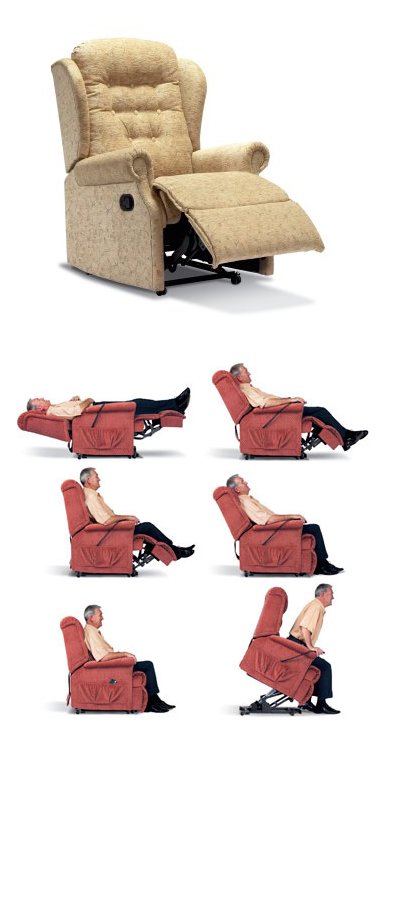
Riser Chair


The Riser Chair tips forward so that the person sitting in it is almost standing up and can get out of it easily.

It works automatically by a power motor operated by a couple of buttons on what looks like a TV remote control.

Riser Chair Foot Drill

To do the foot ball drill we have to have Velda's 'good' foot strapped down. Also, her 'good' hand is in the mitt- or inside her pull-over or button down sweater. In fact, to make this work - we have to tie up BOTH of her hands. Otherwise she will UNCONCIOUSLY use her 'good' foot or either hand that is free to try to help pull back her leg. It is at this point that you don't want some stranger looking into the room and wondering what you are doing to this poor lady!

Then we sit in front of her and to the side and put a basketball on a short 'peanut' can. We tried a lid - but she would just push the ball off with her toe. We tried the dog bowl - but she couldn't get the ball out. The 'peanut can' was it. Just the right height so that I could demand a kick rather than a push.

Foot Drill

When we started the foot drill Velda was only able to slide her foot along the floor. It was very hard to get her to pull it back. One had to ask several times, and sometimes she just couldn't do it. By the middle of the second week, when these pictures were taken, she was kicking all the way up to my hand every time and pulling her foot back without being asked.

There are two parts to the foot drill.
Pull back - and Kick

"Pull your foot back."
"Pull it back more."
"Pull it back still more."
"Okay - now wait until I say kick."
"One, two, three - kick!"
"No, that was just a push."
or-
"That was sorta a kick."
or-
"That was a good kick!"

And we did it again, and again, and again, hundreds of times. If Velda started straining - or couldn't get the foot back - or was leaning forward and breathing heavily - we stop for a minute and take deep breaths - and relax - and start again - until she could eventually pull her foot back and can give a real kick.

In the above picture you can see how Velda's good foot is tied to the chair.

A REALLY Weird Drill

If you think that the tied foot and ball kicking is wild - there is no telling what you would think if I told you about what I think is our big breakthrough for the Lower-limbs.

Lying in bed one night, I said,
"Lord, we need a breakthrough.
We need a miracle."

The very next day three of the oddest things came into and together in the house for totally different reasons and there is no way that a clinic or hospital or 'professional people' are going to do this. Okay, maybe you wouldn't either - but you could get a teenager to do it. But - that is another story, and I am only going to tell people about it who have made progress with what I have already said here.

You see, the reason why mCIT is important for the lower limb is because it is NOT about moving that leg or walking but rather moving that leg INSTEAD of the other one - and unless the other leg is RESTRAINED - you will never know which leg is obeying which command.

One way that I can tell with Velda is that when we came to steps to go into the house I would tell her to move her 'bad' right leg first. She couldn't do it. She couldn't bend the knee and lift it up although the 'good' leg would be holding all her weight. Once she was up with the good leg - then she would drag the bad leg up. Eventually she could bend the bad leg just fine to kick, but still couldn't step up with it first. So what was the difference? It was just in the mind. Sometimes she could move the right leg first. And then eventually up three steps in a row - right leg first.

People just give up on mCIT for the lower-limb because it is too difficult (and dangerous to do - if you are trying to do it with something like walking). But mCIT for the upper-limb is only half the task.

Yes, it is nice that people gain control of an upper limb and can do things like feed themselves, but if that is all - then they are still in a wheel chair. And yes, we know what it means to be in a wheel chair. Jean was in a wheel chair the whole time we were in Germany at the language conference last summer. Now she is walking without a cane which to us is another miracle and and another story.

Jean had two knees replaced. Velda had two knees replaced and a hip. My mother had a hip replacement. So yes, we know about wheel chairs. Dana (see our true story below) is still in a wheel chair. Velda wants to walk. We are working on it.

Treadmill Therapy

There is a lot in the literature about treadmill therapy for stroke patients. It is a good follow on after the ten days of CIMT or mCIT. Otherwise the treadmill, while strengthening muscles, could be reinforcing the adaptive and non-corrective response to the stroke.

While restraints supportive of the user have been used in connection with treadmills and are popular in some clinics - clinical studies have nevertheless shown these restraints/supports to be ineffective. (The exception being the elastic bandage described in another section.) That does not mean that the use of a treadmill is not beneficial.

Look at the following articles:

Treadmill exercise improves walking after stroke

Treadmill Exercise Retrains Brain And Body Of Stroke Victims

Treadmill walking aids stroke survivors

    "The study involved 71 patients, of an average age of 63, who had a stroke at an average of about four years earlier."

    "About half were selected to walk on a treadmill for 40 minutes, three times a week for six months, while the rest did stretching exercises for the same amount of time instead of using the treadmill."

    "In the treadmill walkers, brain scans detected increased activation in brain areas associated with controlling gait and walking, including the cerebellum and midbrain, the researchers said. No such changes were seen in the others."

There are also all sorts of weird and wonderful devices out there that are supposed to do wonderful things. I wouldn't know because I sure don't have the money to buy these toys and I don't know anyone else who does either.

New Device For Stroke Patients Improves Walking

Weird treadmill may tap nerve networks for better walking post-stroke

A treadmill is really of no benefit until one can get up to the point where they can use them with a correct step and that is where I feel CIMT/mCIT therapy can be of benefit.

One wants to eventually learn, as shown above, to walk without holding on with their hands.

We buy our treadmills used and have learned through experience that you don't want to get one that has been used by a heavy individual. The second difficulty is making sure that it runs SLOW enough. It is more difficult for a treadmill to run slowly than fast and the mechanisms wear out. The first one we got home - burst into flames two weeks later.

We paid a hundred dollars for the excellent one we have now but it is best to spend an extra hundred and to get a good one because they are expensive to repair. If you are careful and shop around you don't have to pay the price of a car to get one - although five hundred or less is what we spend for our cars also.

Backwards Walking Therapy

The second method that researchers found very beneficial for lower-limb improvement is backwards walking.

    "Gait outcomes after additional backward walking training in patients with stroke: a randomized controlled trial"

    "Subjects in both groups participated in 40 min of conventional training programme three times a week for three weeks. Subjects in experimental group received additional 30 min of backward walking training for three weeks at a frequency of three times per week."

And another backwards walking study.

    "Improving gait outcomes in stroke patients using backward walking"
There are very sound reasons why backward walking is so beneficial - but I am not going to get into such minute details about this or many other areas.

The clinical studies did the backwards walking for only eleven hours - but that may have been just the studies and you may want to do it more.

I wouldn't make a big investment into parallel bars. Some therapists recommend that one do the backwards walking on a treadmill and once again they say the goal should be to do it without holding on. My position is that the CIMT/mCIT therapy comes first - but that is pretty obvious if the patient is sitting in a wheel chair and unable to walk.

Leg Restraint mCIT

The following is an abstract of one published study using an elastic bandage.

      In recent years, many study reports have been submitted about the effect of functional recovery of the paralyzed limb by constraint induced movement therapy (CIT). However, since CIT limits the healthy limb for a long time, it is problematic for clinical use. In this study we tried modified constraint induced therapy (mCIT) which was CIT revised conditions that we could carry out practically. The subject was a patient with disturbance of right lower limb voluntary movement due to cerebral infarction of the left medial frontal lobe including the supplementary motor area. The patient's non-paralyzed knee was fixed in an elastic knee brace for two days. After mCIT, it appeared that voluntary movement of the right lower limb had improved with marked improvements in various movements and gait ability. These changes in two days exceeded the natural recovery process after a cerebrovascular accident, and we judged it to have been effected by mCIT. The background to these improvements is thought to be the supplementary motor area, which activates early in the process of motor recovery and dominates the limbs of both sides."

Because one could do damage by cutting off circulation it may be best to have the bandaging done by a professional and to use the procedure ONLY TWO DAYS AT A TIME with a weeks rest in between if you decide to repeat it. You may only need to do the ankle and knee but there is less chance of bandage slippage if the whole leg is done.


.

.

Article by:
Dr. David G. Williams

Other research shows dramatic benefits for stroke patients recovering control of a stroke-damaged arm or leg after practicing a technique completing exercises in front of a mirror.

It the study, 10 stroke patients practiced movements in front of a mirror over a six-month period. The mirror reflected the motions of their good arms or legs, and the patients tried to copy those movements in the stroke-damaged arms or legs. The results were dramatic.

After only four weeks of "mirror therapy" all of the patients had noticeable improvements. Patients who were given the same exercise instructions, but without the mirror, didn't experience any noticeable improvement.

No one is exactly sure what is happening here. I suspect, as with other illnesses, that the process of healing begins in the mind. Perhaps watching the movements of a healthy limb triggers "memories" of normal movement in the brain. The damaged limb then begins to mimic these normal movements, thereby accelerating recovery.

The best thing about this therapy is it's inexpensive, non-invasive and it's easy to do in your own home. All you need is a full-length mirror--the ones that are designed to be attached to the back of doors are available everywhere. Once it's in place, stand or sit in front of mirror at a distance that allows you to see your hand or foot when the arm or leg is held out to the side.

Now, concentrate on watching the normal limb perform different movements in the mirror (lifting up, rotating, etc.), while trying to move the stroke-damage limb in the same manner. The brain will begin to "see" the movements of the normal limb and then "remember" how to use the damaged limb. It will obviously take time and patience, but there's no doubt this simple technique will speed up the entire rehabilitation process.

............

Mirror Therapy Research

Thirty minutes per day of the mirror therapy program, consisting of nonparetic ankle dorsiflexion movements
Altschuler is a key name

Here is another abstract

How to build a mirror box

why mirror therapy works

see wikipedia article

Mirror Therapy

The type of full length mirror that we are talking about can be gotten for ten or fifteen dollars. You can hang it on a closet door if you wish and with the door open it will work just as well there. Which side of the door you need to hang it on is determined by which side of the body is affected.

This website explains how to use your mirror on the door as shown in the following two photos.


There are also some interesting mirror therapy gadgets out there.


watch the video at this link.

Test Device
We use the test device ONLY for testing. We Do NOT use it for drills! That is called teaching the test and is a "no-no".

Here is a picture of the test device.


Because I wanted to be able to quantify the results I developed a scale that I call the Mansfield Movement Measurement scale. The device for measuring on this scale is easily obtainable. I used The Original Rollercoaster $49.95 from Anatex and established the scale by having a number of healthy adults work against a 5 minute timer to determine how many balls they could move one at a time across the orange wire. The median rounded to almost exactly fifty and so we assigned a value of two to each ball for a scale of 100.

You don't have to do a pre-test and and post-test but it helps to quantify what you have accomplished. I chose this device because it is readily available and it is quite possible that you can borrow one from somewhere like a nursery.

Part Five
What is happening -
is not what you think

I think that this is the most important part of what I am writing here. The most important thing on this whole web page. The most important thing that I have to say - so I hope that you will really try to understand what is being said here. First, I want you to go and look at another MUST SEE video.

What you are looking at is the classical CIMT procedure and the mCIT method that I am proposing is just the opposite. Why it is the opposite and how it works will take me a little while to explain.

First of all, most people will say that they understand that stroke is not a physical problem. They will say that - but they don't really understand it because the physical therapist will say that they still need to do manipulation of the body. The doctor will say that he needs to give a medicine to relax the muscles - and so forth. Maybe they will say that brain is another physical organ of the body, and that the cells have been damaged and that they need to be repaired or circumvented.

But no, the problem is in the mind. So what and where is the mind? Well, I am not going to go there. You don't have to believe what I believe - you only have to consider doing what we did. We all come from different backgrounds. I happen to have been trained by the Massachusetts Metaphysical College to become a Christian Science practitioner. I later took university graduate courses in subjects like psychoanalysis and worked in the field of psychiatric social work. And Rae, who worked with me to help develop the interpersonal techniques, trained in Hakomi Body Centered Psychotherapy and Hypnotherapy. I am not saying that all this gave us all of the answers - or any of the answers - but rather that it just shaped my viewpoint. Still, what works is what works and I can only report to you what I see working.

So, what is Mind? What is it that controls the body? We are talking here more about the mental-physical rather than the metaphysical. The mental and the physical. Not to worry - we won't go there. But still, everyone is saying the mind (whatever that is) is controlling the body. If it isn't - then the body is dead - or at least damaged. So, in some way they think the stroke victim has a 'damaged body' and they want to fix the body. I am just saying that we need to fix the mind and I know the doctor and his drugs and the physical therapist can't bear to hear that. But - let us look at how we can do it.

You looked at the video and you saw what they were doing with Buddy.
Try.
Try harder.
Use your will.

Nope - I am saying do the opposite. Reminds me of the fellow who met a caterpillar with a hundred legs and he asked the caterpillar how in the world he ever kept a hundred legs coordinated. The caterpillar thought about it - and could never walk again. Honestly, that is the answer. Don't think about it.

But that is the problem. If I tell you to NOT think about it - you can only think about it. If I tell you to NOT think about a pink elephant you will think about one. See - I told you to NOT think about one - and there you are - thinking about one. Stop it. Stop it RIGHT NOW! Quit thinking about a pink elephant. You can't do it. Are you still thinking about that pink elephant? Yes? Well stop it.

That is the stroke victim's problem. We don't want them to think about moving their hand - because just like the caterpillar - then they can't do it. You don't believe that - but in a few moments I will give you experiments to prove that it is so.

But first, how do we get the mind/body to do what we want it to do? How does the caterpillar get its legs to move correctly? If it can do that for a hundred - surely we can do it for two! This is how mCIT works. We tell the body that we want to move a ball and it will try to move it with the 'good' hand and then when the 'good' hand can't move it - it will try to find another way.

When we tell Velda to move back her foot the body trys every which way to do it. It tries moving her 'bad' foot by pushing it with her "good" foot. It tries moving it with her 'good' hand. It tries with her 'bad' hand. If she could stick out her tongue and move it with her tongue then the body would do that. The only pathway open is with the unrestrained 'bad' leg. So - the body searches for a way to do that and if we get a little movement (so tiny you can hardly see it) we say - "Great!" "Good show!" "You are doing it!" And we will try again.

But - we DON'T use will to coordinate the caterpillar feet. We have to ignore them - just like the caterpillar. So we use diversion. We have to think about something else. I have done it a hundred times.

"Velda - let go of that!"
Strain - struggle. She can't do it.
She can't stop thinking about doing it.
She can't stop thinking about the pink elephant.

"Here Velda, take these scissors."
Zip -and her hand lets go of what she is holding -
and reaches out to grab the scissors.
I snatch the scissors away.
Her hand goes back towards what she was holding.
I push forward the scissors.
Her hand goes toward the scissors.
Back and forth.
We laugh.
Then her hand is free.
She can take or leave either object.

Have you ever heard how they catch a monkey? The hunters take an orange and put it in a glass jug and chain the jug to a stake. The hunters then go away and the monkey comes down out of the tree to get the orange. It puts its hand into the bottle - but once it grasps the orange it can't pull it out and it isn't able to let go of the orange. The hunters return and the monkey screams in terror as they approach but it is unable to let loose of the orange and to run back up the tree.

Can we hold the monkey's good arm and offer it a banana - so that it will let go of the orange and take the banana? If so - that is called diversion. Anyway, that is what we do with people. They have to do it - and do do it - instead of thinking about it.

Stressing and straining will not help get the hand out of the bottle. It will only increase the terror.

We say, "Stop!"
"Look at me!"
"Take my hand!"

Diversion - our number one tool.
Relaxation - our number two.
"Sit back and relax, Velda."
"It is okay, you are doing well."
(She may still be holding onto the object)

Breathe!"" - our number three tool.
"Take deep breaths - in and out - in time with me."
The mystery of breathing.
If we stop - then that is it.
We breathe out - but then we don't breathe in.
It is said we 'expire'.

Yoga, Zen, Sufi, Meditation,
Swedenborg, breath, life, nature of the soul,
all so many things having to do with proper breathing.
If people are excited, angry or tense - then you need to change their breathing.

Sit back, relax, breathe -
and visualize - our fourth tool.
Perhaps not good to visualize
opening and closing your hand
(at this moment if she is still
holding the ball)
but visualize walking down a
beautiful pathway -
or something else that one enjoys -
because at this time we need diversion.

Sometimes there is confusion.
Velda will look at me with a strange little smile -
because all the ball will do
is make strange little circles in the pan
when she wants to move it from one pan to the other.

But immediately we will intervene.
No stress, no strain, no struggle.
Relax, Divert, Breathe, Visualize.
Take a break.
The opposite of what you saw on the video.

Biometric Feedback

Forty years ago I received a government grant to do a study on using biofeedback. We used an electroencephalograph to measure the biometric effects of meditation on the alpha and beta waves in brain. Like other experimenters, we had definite measurable results in being able to control the waves. Other experimenters showed that they were able to do weird things such as teach their subjects to raise the blood pressure on command in just one of their ears.

It is using these demonstrated powers of the brain/mind that we expect to be able to teach it to move a limb through new neural pathways.

How it Works!

It isn't the muscles.
Nothing needs to be massaged -
or medicated.
It isn't even the brain -
because it too has alternate pathways.
It is mind and only Mind.
It is the Divine Dance -
to the Divine Melody.
The Song of God -
being sung soul to soul.

It isn't moving and counting balls -
making marks upon the paper -
clicking the stop watch -
struggling and straining.

But it is a struggle and strain
for the helpers -
and they don't stay around long enough -
for me to teach them the Divine Melody -
that they are to sing soul to soul.
That what they are doing -
is helping a soul to hear that Melody-
to respond to that Mind that directs all.

You don't have to believe
any of these things that I am telling you -
you only have to do them.

Part Six
A True Story

This TRUE story has been moved to the Story of Velda. It is a continuing story of her improvement.

Part Seven
What do you want to do?

If you are serious about using this mCIT method then you need to spend some hours studying this process but that is nothing compared to the effort you will have to make to implement it.

We had GOOD success even though we had some real cards stacked against us.

    a. Most people will just give up on someone who is over eighty years old - but this just goes to show what can be accomplished even at that age. For all I know, it could be harder with a child - but possibly not, if it is like someone playing with them.

    b. It is difficult when you have doctors, physical therapists and others opposed to what you are doing - but we had great support from many members of the family.

    c. What may have been working most against us was that we had to remove the restraint most of the day. The stated goal of the process is for the person to wear it 90% of the time - but we couldn't do it while Velda was in the nursing home. With bathroom trips, going on walks with the walker, etc. she probably didn't have the restraint on more than five hours out of the day and not at all on weekends and so therefore only 15% instead of 90% of the time. Of course it was on during the times that she was doing the drills and that is what counts most.

    d. Some people may read that and say - "Well, it just goes to show that you didn't know what you were doing." However, my advice is - don't let people stop you because they say you aren't a 'professional', don't have experience, or whatever. One just has to do the best they can do.

    I do think it would be better to use the restraint full time during the 14 days and if your patient is in a nursing home - here is what you might do. You could have the nursing home supervisor look at this web page and if they would agree - you could conduct the ten days of therapy in a visiting room - and they might even agree to your patient wearing the restraint all the time. But this way you would have someone else doing the meals, bathroom trips and such and you wouldn't have to be taking the patient back and forth each day - and not having them at home or in your motel room if you have to travel to say where a parent is in a nursing home. This way you could relax in the evening and get a good nights sleep.

    I have thought of telling people that they could do it in a motel room near to us and that I would try to help them - but I can tell you this, you need all the help that you can get. Just one person trying to do it will probably completely exhaust the patience of both you and the subject.

    I really think it is too much for a couple to take on by themselves - say a wife, who is trying to look after her husband and they are living alone. I know that it is a terrible burden looking after a stroke victim and that such improvement as I have described would be a real boon - but in my opinion you need help.

    The same is true of a mother who is looking after a family and who has perhaps a younger stroke victim in the family. Giving ten days of mCIT therapy to a single person is more than a full-time job for a single person. It is a full-time job for several people.

    If there is some way that I can help you - write to me at:

    [email protected]
    with the subject line as: stroke
    or I can be reached at (519) 925-6035